
'An important consideration was that we should always be at the top of the escalation ladder. When we reach a military objective, we should try and put a stop to it'
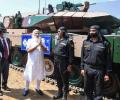
The tank, designed, developed, and manufactured by the Defence Research and Development Organisation's Combat Vehicles Research and Development Establishment and made in Tamil Nadu, will be used to protect northern borders.

The HSTDV is capable of powering missiles to attain a speed of around Mach 6 or six times the speed of sound, the officials said, adding only a very few countries like the United States, Russia and China have such a capability.

The defence budget was increased to Rs 5.94 lakh crore for 2023-24, up from last year's allocation of Rs 5.25 lakh crore.

In the last 11 years, India and the world witnessed what he stood for, what he promised and did not deliver, and what he actually stood for and practised without fearing how history would judge him. Modi's tenure has been punctuated with headline-grabbing decisions, symbolic gestures, and stage-managed moments that continue to define his leadership and India's politics, points out Ramesh Menon.

Last fortnight, State Bank of India Chairman C S Setty lifted the veil on a subject long spoken of in corporate corridors: Why can't our banks finance mergers and acquisitions (M&As)? Change is in the air: Indian Banks' Association (of which Setty is the chairman) is to "make a formal request" to Mint Road to make way for it. Thus far the exclusive turf of foreign banks even though its funding remains offshore - as in, it's not on these entities rupee-book (and a few select shadow banks) - a most lucrative segment in the investment banking suite, M&As, will be homeward-bound.

Experts said India has possessed the anti-missile technology for several years but needed the political go-ahead to actually test it in live conditions.

With Prime Minister Narendra Modi stressing on the need for increasing arms exports, the Defence Research and Development Organisation has said India can sell combat aircraft and missiles whose production cost would be "much lower" than some of the weapons sold by countries such as China.

The QRSAM system is unique in its ability to operate on the move, searching for and tracking enemy targets; and then fire on a short halt.
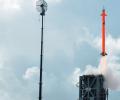
In a bid to galvanise its air defence capabilities, India on Tuesday successfully test fired a new, long range surface-to-air missile jointly developed with Israel from a defence base off Odisha coast.

It said the ATGM has been developed with a capability to launch from multiple platforms and is currently undergoing technical evaluation trials from 120 mm rifled gun of MBT Arjun.

The interceptor is a 7.5-metre long single stage solid rocket propelled guided missile equipped with a navigation system, a hi-tech computer and an electro-mechanical activator, the DRDO sources said.

The defence ministry said the test-flight was carried out on Wednesday evening and it met all the trial objectives, validating the reliable performance, as confirmed from the data captured by a number of range sensors deployed at different locations.
M R Srinivasan focused on the peaceful use of nuclear power at a time when the popular view among the 'hawks' was that India should build a nuclear arsenal as a deterrent.

It said clinical trials of the drug 2-deoxy-D-glucose (2-DG) showed that it helps in faster recovery of hospitalised patients and reduces supplemental oxygen dependence.
The DRDO and European defence consortium EADS have successfully developed an advanced missile warning system and will start its serial production soon. Announcing this during the ongoing Berlin Air Show, the Netherlands-based EADS said it looked at India as a manufacturing hub from where the technology could be exported to other interested countries.

The customs officials, based on an intelligence input, halted a Malta-flagged merchant ship -- CMA CGM Attila -- at the port en route to Karachi on January 23 and inspected the consignment, which included a Computer Numerical Control (CNC) machine, originally manufactured by an Italian company.
India on Friday successfully test-fired an indigenously developed supersonic interceptor missile, which is capable of destroying a hostile ballistic missile, from a test range off the Odisha coast. "At around 12.52 pm, the interceptor hit the target missile successfully at an altitude of about 15 kilometres," said Defence Research and Development Organisation spokesman Ravi Kumar Gupta.

India on Friday night successfully conducted maiden night test of its indigenously developed nuclear-capable Agni-I ballistic missile with strike range of 700 km from a test range off Odisha coast as part of a user trial by the Army.
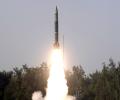
At present, the Pralay ballistic missiles can take out targets from 150 to 500 km and are extremely difficult to intercept for the enemy through interceptor missiles.

Like the Shourya and Prahar missiles, the Pralay is powered by conventional solid fuel, and its payload is designed to carry only a conventional warhead.

The Indian Army has initiated this proposal worth around Rs 1,000 cror Swathi WLRs and it is planned to be put for consideration by a high-level defence ministry meeting.

The missile was fired from a ground mobile launcher at launch pad number-1 of the Integrated Test Range (ITR) near here at 3.55 pm, and it hit the target with accuracy, the sources said.
India is developing a 5,000 km-range Agni ballistic missile, Defence Minister A K Antony said on Monday.
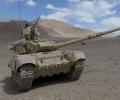
DRDO's latest tank will face trial in Rajasthan's summer which will be followed by 'user trials' ahead of facing battle in high-altitude deserts of eastern Ladakh and Sikkim, reports Ajai Shukla.
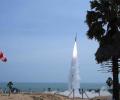
The fuel cost will come down if rockets are launched from Kulasekarapattinam as they will have a straight trajectory and need not have to avoid Sri Lanka, which is being done by rockets flown from Sriharikota.

To threaten China and Pakistan, and then to sharply cut back on military funding, bespeaks a remarkable trust in Beijing and Islamabad that is not borne out by anything they say or do, notes Ajai Shukla.
'It is typical of China's strategic deception of making virtue out of necessity,' observes Rup Narayan Das.
The unguided rocket system is meant to neutralise bigger geographical area with rapid salvo of rockets. With a range of 40 km, 'Pinaka' can fire salvo of 12 rockets in 44 seconds. One salvo each (12 rockets) from the battery of six launchers can neutralise at a time a target area of 3.9 sq km.
India has decided to buy sophisticated equipment worth Rs 2000 crore to counter nuclear, biological, and chemical terrorism and covert attacks.

"A mere 5-6 per cent of defence budget for R&D is inadequate to meet the aspirations of India's defence needs especially when China spends about 20 per cent of their defence budget for R&D," said the DRDO chief.

The missile test was carried out from a mobile launcher from launch complex-3 of the Integrated Test Range at about 10 am, defence officials said.

The Lucknow-born Shukla, former NASA astronaut Mission Commander Peggy Whitson, Slawosz Uznanski-Wisniewski of Poland, and Tibor Kapu of Hungary are part of the Axiom-4 mission that marks the return to space for the three nations.

Saraswat played a key role in developing a series of missiles at a time when India faced tight international technology sanctions.

The missile has been developed to engage highly fortified enemy tanks in day and night conditions.

The setting up of STEAG is part of the Army's efforts to develop technologies considering the future battlefield, they said.

The surface-to-surface missile, a naval variant of the indigenously-developed 'Prithvi' missile, was test-fired from the ship positioned near Paradip in the Bay of Bengal at around 10.52 am, the officials said.

The state-of-the-art advanced missile, a product of joint venture between India and Israel.

The 'Agni P' is a two-stage canisterised solid propellant ballistic missile with dual redundant navigation and guidance system.
 © 2026 Rediff.com - Advertise with us - Disclaimer - Privacy Policy - Sitemap - Feedback - About us - Terms of use - Grievances